
Lessons From Real Inspections: HVAC Mold Insights for Homes in Broward County
If HVAC systems could talk, a lot of Broward County homeowners would be shocked by what they’d hear. From real inspections—not guesses, not scare tactics—we’ve learned the same lesson over and over: HVAC mold starts small, spreads quietly, and gets expensive only when it’s ignored.
This isn’t about worst-case scenarios. It’s about patterns we see across Broward County homes every week. Let’s break down what inspections actually reveal, where mold usually starts inside HVAC systems, and what smart homeowners do differently.
Where HVAC Mold Actually Starts (It’s Not Random)
Mold doesn’t pick a spot because it feels like it. It grows where moisture sticks around the longest.
From real inspection reports, HVAC mold most often starts in:
- Evaporator coils with constant condensation
- Drain pans holding standing water
- Air handler cabinets with poor insulation
- Duct interiors where dust and moisture combine
Ever wondered how an AC can cool perfectly but still smell musty? Cooling works. Moisture control didn’t.
Why Broward County Homes See HVAC Mold So Often
Broward County creates ideal conditions without trying.
Inspection patterns show:
- AC systems run nearly year-round
- Indoor humidity often stays above 55%
- Homes stay sealed for energy efficiency
- Older HVAC systems struggle with moisture removal
That means HVAC components rarely dry out completely. Mold loves consistency, and Florida delivers it daily.
Condensation: The Real Driver Behind HVAC Mold
If inspections had a headline, it would be this: condensation causes most HVAC mold problems.
What we consistently find:
- Moisture forming during every cooling cycle
- Drain lines partially clogged or slow to drain
- Insulation staying damp long after the system shuts off
Once condensation becomes routine, mold doesn’t need a flood or leak. It settles in quietly and waits.
How HVAC Mold Spreads Through the Home
Here’s where costs climb. HVAC systems don’t just host mold—they distribute it.
From real inspections, the spread usually looks like this:
- Mold grows inside the air handler or ducts
- Spores enter the airflow
- Supply ducts carry spores room to room
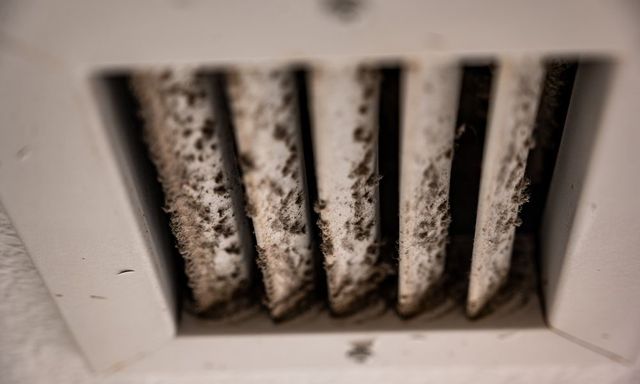
- Mold appears near vents, walls, or ceilings
IMO, HVAC systems act like mold highways when moisture isn’t controlled.
Real Inspection Lesson: Mold Rarely Stays Contained
One of the most consistent findings across Broward County homes: HVAC mold almost never stays in one place.
We often document this progression:
- Mold in air handler → mold in ductwork
- Mold in ductwork → mold near vents
- Mold near vents → mold on walls or ceilings
By the time homeowners see visible mold, spores have often circulated for months. That’s airflow doing exactly what it’s designed to do.
Why Air Filters Don’t Stop HVAC Mold
This myth shows up constantly. Air filters help airflow, not mold prevention.
Filters do not:
- Stop condensation
- Remove mold growing on coils or drain pans
- Clean contaminated duct interiors
- Prevent mold growth upstream
FYI—changing filters still matters. It just doesn’t fix HVAC mold. Different problem, different solution.
Ductwork: The Cost Multiplier Inspections Catch Late
Once mold reaches ductwork, inspection reports start using words like “widespread” and “embedded.”
Common duct findings include:
- Dust-lined interiors holding moisture
- Insulation absorbing condensation
- Mold embedding into duct lining
At that point, cleaning has limits. Replacement often becomes the practical solution, and that’s where costs jump fast.
HVAC Mold and Indoor Air Quality
No scare tactics—just patterns. Homes with HVAC mold almost always report indoor air quality complaints.
Common homeowner feedback includes:
- Musty odors when the AC turns on
- Allergy flare-ups indoors
- Headaches that improve outside
- Fatigue in certain rooms
These don’t diagnose mold. But when inspections follow, HVAC contamination often explains the pattern.
How Inspections Track Mold Spread Accurately
A proper HVAC mold inspection doesn’t stop at one component. It follows moisture and airflow.
We look at:
- Where moisture starts
- How air moves through the system
- Which components stay damp longest
- Where spores are likely traveling
This approach shows how far mold has already spread, not just where it began.
Mold Testing: What It Helps With (and What It Doesn’t)
Testing supports decisions—it doesn’t replace inspection.
Testing helps when:
- Mold isn’t visible
- HVAC involvement is suspected
- Multiple rooms show symptoms
- Documentation is required
Testing doesn’t help when the remediation plan won’t change. Keep it practical.
HVAC Mold Removal vs. HVAC Mold Remediation
Inspection outcomes make this difference very clear.
HVAC Mold Removal
- Targets visible mold
- Short-term improvement
- Higher recurrence rates
HVAC Mold Remediation
- Addresses moisture sources
- Cleans or replaces contaminated components
- Uses containment and filtration
- Dramatically reduces recurrence
From real inspection follow-ups, remediation wins every time.
Why HVAC Mold Keeps Coming Back in Some Homes
Repeat cases aren’t random. Inspections show clear reasons.
Most repeat HVAC mold problems happen because:
- Condensation issues weren’t fixed
- Indoor humidity stayed high
- Drain lines weren’t maintained
- Inspections were skipped
Mold doesn’t come back—it resumes when conditions never changed.
What Actually Reduces HVAC Mold Risk
You don’t need extreme upgrades—just consistency.
Inspection-backed prevention steps:
- Keep indoor humidity below 55%
- Flush AC drain lines regularly
- Address condensation immediately
- Schedule HVAC inspections, not just tune-ups
- Don’t ignore musty odors
Small habits protect big systems.
Final Thoughts: HVAC Mold in Broward County Is Predictable
Real inspections across Broward County tell a consistent story. HVAC mold follows moisture. HVAC systems spread it efficiently. Costs rise only when time gets involved.
The good news? When homeowners act early, HVAC mold stays manageable, contained, and far less expensive to fix. If your AC smells off, humidity feels high, or symptoms show up indoors, trust the signal. Early attention always beats late cleanup.
