
Mold and Allergies Are Best Friends (Unfortunately)
Let’s get one thing out of the way.
Mold and allergies didn’t just meet — they basically moved in together, split the rent, and decided to make your home uncomfortable.
If you’ve ever wondered why your allergies flare up indoors, why sneezing starts only at home, or why sinus pressure magically disappears when you leave the house… yeah, mold often plays a starring role.
And no, this isn’t hype. This is what we see over and over inside real homes.
So let’s talk honestly about why mold and allergies get along so well, what most homeowners misunderstand, and why ignoring this connection usually costs more later.
Why Mold and Allergies Get Along So Well
Mold survives by releasing spores into the air.
Allergies react to airborne irritants.
You can already see where this is going.
When mold grows indoors, it releases microscopic spores that float through the air you breathe every day. You don’t need to touch mold. You don’t even need to see it. You just need to inhale the air around it.
Your immune system notices these spores and says, “Nope.”
Then it overreacts.
That overreaction triggers allergy symptoms.
Simple. Brutal. Effective (for mold, not for you).
Mold Spores Live Where You Breathe
Here’s something most homeowners never think about.
Mold doesn’t stay politely on walls.
It moves through:
- Indoor air
- HVAC systems
- Ductwork
- Furniture fabrics
- Carpets
- Curtains
Every time your AC turns on, it pulls air — and whatever’s floating in that air — across your home.
If mold exists anywhere in the system, spores circulate everywhere.
That’s why symptoms often feel “house-wide” instead of room-specific.
Why Allergy Symptoms Don’t Always Make Sense
This is where confusion kicks in.
Many homeowners say things like:
- “I don’t see mold anywhere.”
- “We cleaned the visible spots.”
- “The house looks fine.”
And yet…
They experience:
- Constant sneezing indoors
- Itchy or watery eyes
- Sinus pressure that never fully clears
- Nighttime coughing
- Brain fog
- Fatigue that improves outdoors
Sound familiar?
Hidden mold causes many of these cases. When mold grows behind walls, under flooring, or inside HVAC systems, symptoms show up long before stains do.
Your body notices before your eyes do.
The Immune System vs Mold: A Bad Relationship
Allergies happen when your immune system misfires.
Instead of ignoring harmless particles, it treats them like a threat.
Mold spores trigger this reaction because they resemble biological invaders.
Your body releases histamines to defend itself.
That causes:
- Inflammation
- Mucus production
- Nasal swelling
- Eye irritation
IMO, this is where mold really earns its reputation — not because it looks gross, but because it quietly wears people down.
Why Kids and Seniors Get Hit Harder
Not all immune systems respond the same way.
Children and older adults often experience stronger reactions because:
- Immune systems are still developing (kids)
- Immune systems weaken with age (seniors)
- Airways are more sensitive
- Recovery takes longer
We’ve seen families where only one person feels symptoms at first. Over time, others start reacting too.
Mold exposure builds up.
The longer it goes unchecked, the broader the impact becomes.
“But I Cleaned the Mold” Isn’t the Same as Solving It
Here’s the hard truth.
Cleaning mold does not stop allergic reactions if spores remain in the air.
Surface cleaning removes stains.
It doesn’t remove airborne contamination.
It doesn’t stop moisture.
It doesn’t clean HVAC systems.
If mold keeps growing behind surfaces, spores keep releasing.
That’s why allergies often return even after cleaning.
It’s not bad luck.
It’s incomplete treatment.
The Role of Moisture (Always the Villain)
Mold needs moisture. Period.
Florida homes — or any humid climate — naturally struggle with moisture because of:
- High outdoor humidity
- AC condensation
- Poor ventilation
- Temperature differences causing condensation
Common moisture sources include:
- AC drain line backups
- Bathroom humidity
- Window condensation
- Slow plumbing leaks
- Roof leaks after storms
If moisture exists, mold finds it.
If mold finds it, allergies follow.
Musty Odors = Active Allergy Triggers
That “old basement” smell?
That’s not just unpleasant.
It’s mold gases called MVOCs.
These gases often appear before visible mold and indicate active growth. They irritate airways and worsen allergy symptoms.
If your home smells musty even after cleaning, something hidden still grows.
Your nose knows.
Why Air Ducts Make Allergies Worse
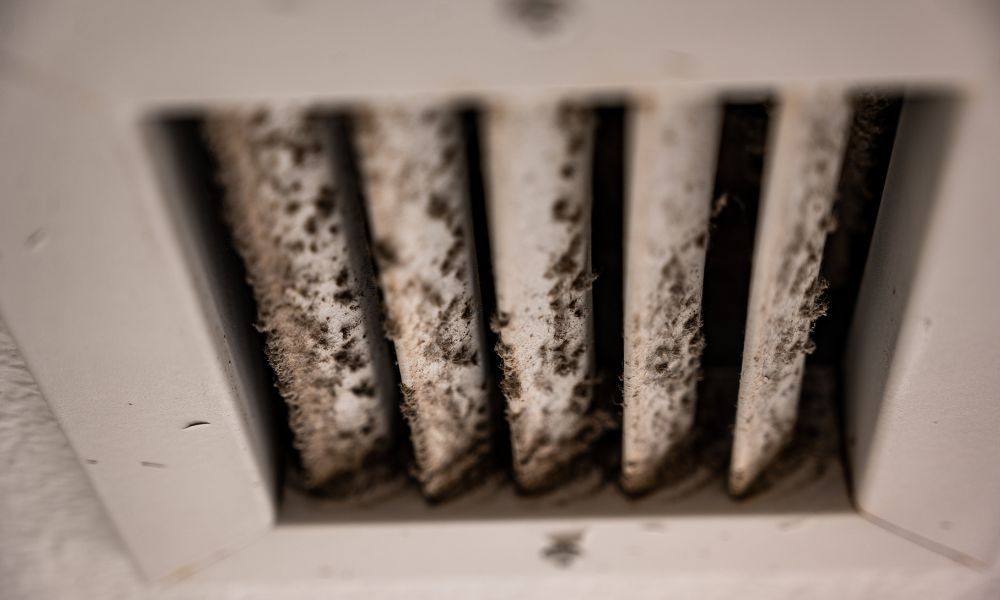
Air ducts act like highways for mold spores.
If mold develops inside:
- The air handler
- The evaporator coil
- Duct insulation
Then spores circulate every time the system runs.
This creates constant exposure, even if living spaces look clean.
That’s why allergy symptoms often spike at night or when AC cycles frequently.
FYI, changing air filters alone won’t fix this. Filters catch dust, not embedded contamination.
Seasonal Allergies vs Mold Allergies
Here’s where many homeowners misdiagnose the problem.
Seasonal allergies usually:
- Improve indoors
- Follow pollen cycles
- Ease during certain months
Mold-related allergies often:
- Worsen indoors
- Persist year-round
- Improve when leaving the house
If symptoms don’t follow seasons, indoor air quality deserves attention.
Why Some Homes Trigger Symptoms and Others Don’t
Two houses can look identical and feel completely different.
Why?
Because mold growth depends on:
- Construction materials
- Ventilation quality
- Moisture control
- Past water events
- HVAC maintenance
A home with hidden moisture problems can trigger allergies even if it looks spotless.
Appearance doesn’t equal air quality.
The Long-Term Cost of Ignoring the Connection
Ignoring mold-related allergies often leads to:
- Repeated doctor visits
- Ongoing medication use
- Sleep disruption
- Reduced productivity
- Worsening respiratory sensitivity
Over time, people become more reactive, not less.
Addressing the environment early often reduces symptoms naturally.
No magic. Just fewer triggers.
What Actually Helps Reduce Mold-Related Allergies
Real improvement usually comes from addressing the source.
That means:
- Identifying hidden moisture
- Controlling humidity
- Removing contaminated materials
- Cleaning HVAC components properly
- Improving ventilation
When spore levels drop, symptoms often follow.
It’s one of the most satisfying changes homeowners notice — quieter sinuses, clearer breathing, better sleep.
Prevention Is the Real Allergy Medicine
You don’t need to wait for symptoms to explode.
Preventive steps include:
- Keeping indoor humidity below 55%
- Fixing leaks immediately
- Running bathroom exhaust fans
- Servicing AC systems regularly
- Addressing musty smells early
Mold doesn’t grow overnight.
It builds slowly.
Catching it early saves a lot of discomfort.
The Real Takeaway
Mold and allergies work together way too well.
Mold releases spores.
Allergies react aggressively.
Homes trap air.
Symptoms linger.
And the worst part?
You can feel miserable without seeing anything wrong.
If allergies worsen indoors, don’t ignore that signal. Your body often detects mold long before walls show it.
Clean air isn’t about appearances.
It’s about what you breathe every minute.
And unfortunately, when mold shows up, allergies rarely stay silent
