
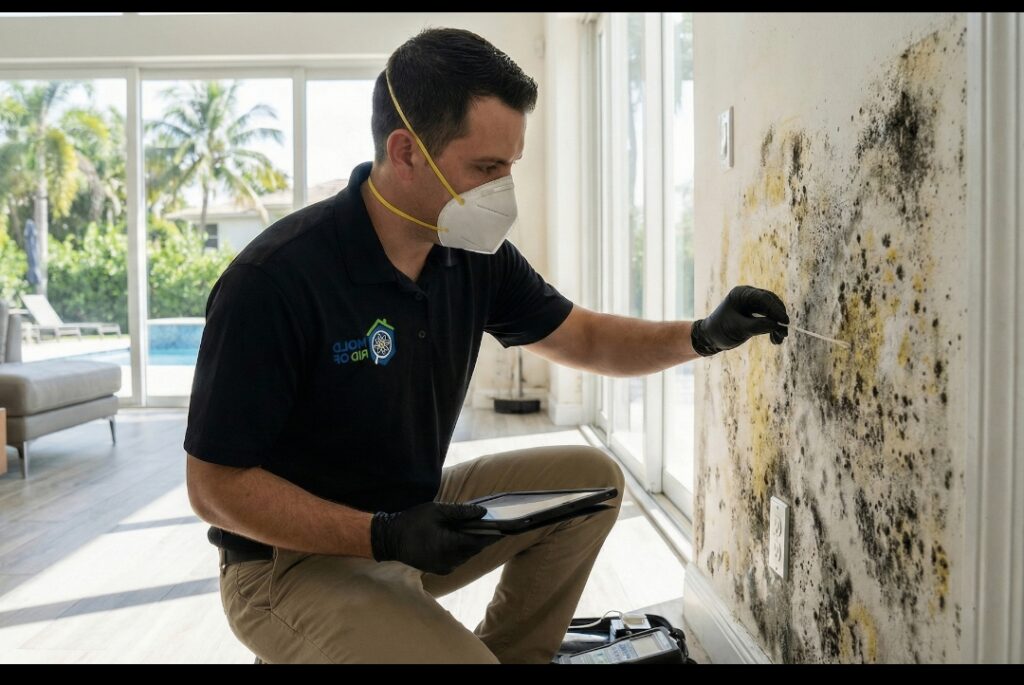
What the Data Tells Us: Mold Testing Insights for Homes in
Mold testing often raises questions for homeowners across South Florida—mainly because there’s a lot of conflicting information out there. When we look at real inspection data instead of assumptions, a clear picture forms. Mold testing is not about panic or proving a worst-case scenario; it’s about understanding indoor conditions and confirming whether mold activity is present when it’s not obvious.
South Florida’s humidity, warm temperatures, and year-round AC use mean mold spores are always part of the environment. Data from inspections helps separate what’s normal from what suggests a hidden problem inside the home.
Inspection data shows that mold testing is most useful when mold is suspected but not visible. Many homes show no staining or obvious growth, yet testing reveals elevated indoor spore levels compared to outdoor air.
Common situations where data supports testing include:
- Persistent musty odors
- Mold that keeps returning after cleaning
- Past water damage with unclear drying history
- Ongoing indoor air quality complaints
In these cases, testing helps confirm whether indoor conditions are contributing to the problem.
From a data standpoint, mold testing works by comparing indoor air samples to outdoor baseline samples. Outdoor air in South Florida naturally contains mold spores, so elevated indoor levels are meaningful only when they exceed what’s expected outside.
Testing data helps identify:
- Whether indoor mold levels are elevated
- Whether spores are coming from inside the home
- Patterns suggesting hidden mold growth
Without comparison data, results lack context.
Humidity plays a major role in mold testing outcomes. Data consistently shows that higher indoor humidity allows spores to remain airborne longer, which can increase measured levels even when growth areas are small.
In South Florida homes, testing often reflects:
- Elevated humidity rather than visible mold
- HVAC-related moisture issues
- Limited ventilation
This is why results must be interpreted alongside inspection findings.
HVAC systems strongly influence mold testing data. Because AC systems circulate air throughout the home, spores from one hidden area can appear in multiple rooms.
Testing patterns frequently show:
- Similar spore types across rooms
- Elevated counts near supply vents
- Indoor levels rising during AC operation
These trends help inspectors narrow down likely source areas.
Another key data insight is that mold testing does not identify the exact location of mold. Testing indicates whether mold activity is present, not where it’s growing.
That’s why professional evaluations combine:
- Visual inspection
- Moisture detection
- HVAC assessment
- Mold testing when appropriate
Together, these tools provide a complete picture.
Inspection data also explains why DIY mold test kits often create confusion. These kits usually lack:
- Outdoor baseline comparisons
- Controlled sampling conditions
- Professional interpretation
As a result, homeowners may worry unnecessarily or feel falsely reassured.
Data shows that mold testing can actually reduce unnecessary remediation. When testing confirms normal indoor levels, homeowners can avoid work that isn’t needed. When elevated levels are confirmed, testing helps focus remediation only where necessary.
This targeted approach:
- Limits disruption
- Reduces costs
- Prevents over-treatment
Skipping testing often leads to guesswork.
Another important data point is timing. Mold testing reflects current conditions, not past problems. A leak that dried completely may not show elevated levels, while ongoing moisture usually does.
This makes testing especially useful when symptoms or odors are present now.
Data also shows that testing is most valuable early. Homes tested soon after concerns arise typically require smaller remediation scopes if mold is found. Waiting often allows mold to spread further.
Early testing supports:
- Faster decision-making
- More accurate remediation planning
- Better long-term outcomes
Professional interpretation is critical. Test results are evaluated in context—humidity levels, building materials, airflow, and inspection findings all matter.
Numbers alone don’t tell the story; conditions do.
Homes throughout face constant environmental pressure that makes mold testing a practical diagnostic tool—not a fear tactic.
